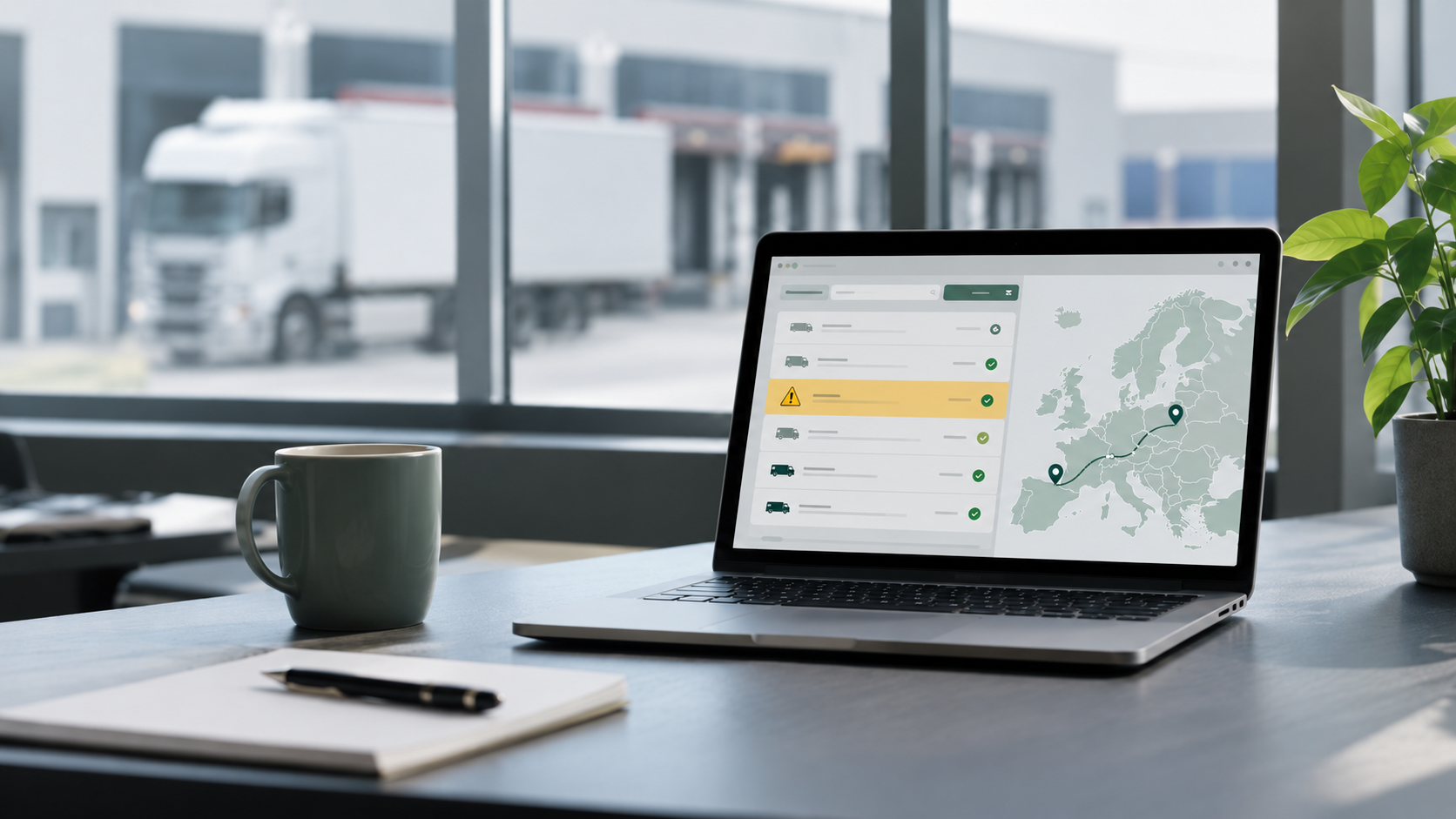
Working with multiple carriers for European road transport is often a deliberate choice. One carrier may have a strong network in Germany, another may offer better coverage in France, while a third may provide greater capacity on specific routes. This creates flexibility, but it also makes transport management more complex.
Five carriers often also mean five different rate structures, SLAs, portals, status updates and ways of working. Without central transport control, this can quickly result in a collection of separate transport flows rather than one integrated European transport network.
Why does European road transport quickly become fragmented?
European road transport becomes more complex as soon as multiple carriers, countries and transport flows need to be managed simultaneously. Differences in rates, systems, service agreements and communication methods make it difficult to maintain one up-to-date view of the entire network.
Companies often deliberately work with several carriers to spread capacity, ensure strong coverage in specific countries or reduce their dependency on a single provider. However, each carrier may apply its own agreements regarding rates, fuel surcharges, waiting times, lead times and exceptions.
Add differences between countries, lanes and customer requirements, and complexity increases even further. As transport volumes and the number of carriers grow, so does the number of exceptions and decisions that need to be managed.
What happens when every carrier has its own process?
When carriers each work with their own portals, systems and processes, transport information becomes fragmented. Employees have to manually collect and combine information before they can understand what is happening across the overall transport network.
Consider a manufacturing company shipping from the Netherlands to customers in Germany, Belgium, France and Italy using five different carriers. One carrier provides track-and-trace information through a portal, another mainly communicates by email, while a third shares status information through a system integration.
When a delivery is delayed, the internal team often has to start investigating. Which carrier is handling the shipment? Where is it currently located? Which agreement applies? And who needs to take action?
This takes time and makes the operation heavily dependent on the knowledge of individual employees.
From individual carriers to one transport network
Central transport control means that different carriers can remain part of the network while being managed through one central control layer. Transport data, processes, KPIs, exceptions and decisions are organised centrally.
Executing transport and managing transport are two different activities. A carrier moves a shipment from A to B. Transport control looks at the network above those individual shipments.
Which carrier is the best fit for a particular lane? Are SLAs being met? Where are structural delays occurring? Which routes create capacity risks? And are agreed rates and surcharges being applied correctly?
The real added value comes from making decisions based on patterns across the entire transport network rather than looking at each shipment individually.
Central visibility across all carriers
Transport visibility provides one current overview of shipments and transport statuses across different carriers. This removes the need to manually collect information from separate portals, spreadsheets and email inboxes.
For the manufacturing company in our example, this means that shipments to Germany, Belgium, France and Italy can all be monitored from one environment. Status information is standardised as much as possible and exceptions become centrally visible.
The question therefore changes from “Where is this shipment?” to “Which shipments require our attention right now?”
This forms the basis of management by exception: employees can focus primarily on shipments where intervention is actually required.
Comparing carrier performance objectively
Carrier performance can only be compared effectively when all carriers are measured against the same KPIs. These may include delivery reliability, transit time, exceptions, cost development and compliance with agreed service levels.
Without standardised data, a carrier may appear to perform well based on perception, while the actual figures show a different picture.
Central carrier performance data makes it possible to identify which carriers perform strongly on specific routes or in particular countries, as well as where recurring issues occur. This information supports carrier management, periodic performance reviews and improvement plans.
As a result, carrier management becomes less dependent on incidents and assumptions and more focused on measurable performance.
Managing delays and exceptions centrally
Central transport control makes it possible to identify exceptions early and manage them through clearly defined escalation processes. This allows organisations to act proactively before a disruption develops into a customer issue.
A delay, lack of capacity or missed delivery window cannot always be prevented. What can be defined in advance is which action should be taken, who is responsible and when an issue needs to be escalated.
For example, the process may start by checking the latest status information, followed by contacting the carrier. If the exception becomes critical, alternative capacity can be investigated or the customer can be informed proactively.
A clear structure prevents every disruption from having to be investigated and resolved from scratch.
Independent carrier selection as part of network optimisation
Independent carrier selection means determining which carrier is the best fit for each route or transport flow based on factors such as price, capacity, service, geographical coverage, reliability and specific transport requirements.
An independent, non-asset-based 4PL provider does not have its own trucks or capacity that need to be filled. This means carrier selection can be based on what is best for the transport network.
That does not mean constantly switching between carriers. The goal is structural network optimisation: which combination of carriers provides the best balance of costs, capacity, reliability and service across all European lanes?
Carrier selection therefore becomes part of a wider network strategy rather than a standalone procurement exercise.
The Control Tower as a central control layer
A 4PL Control Tower acts as a central control layer above individual carriers, systems and transport flows. It brings information together, standardises processes and supports both daily transport control and continuous improvement.
Existing carriers therefore do not have to disappear. The main change is the way they are managed.
By analysing transport data centrally, organisations can identify where delays occur structurally, where volumes could be distributed differently and where another carrier or contractual agreement may offer better results.
Transport control therefore becomes an ongoing process rather than a one-off optimisation project.
When does central transport control become relevant?
Central transport control becomes particularly relevant when the complexity of the transport operation grows faster than the organisation’s ability to manage it using existing processes.
Common signals include:
- working with multiple carriers across several European countries;
- transport information being spread across portals, spreadsheets and email inboxes;
- no single up-to-date overview of all shipments;
- difficulty objectively comparing carrier performance;
- employees spending significant time managing exceptions and escalations;
- critical knowledge being concentrated with a small number of employees;
- growing transport volumes, markets or numbers of carriers;
- a need for more control without fully outsourcing transport activities.
In these situations, the solution is not necessarily to reduce the number of carriers. Instead, it may be more effective to improve the way the existing carrier network is managed.
From organising European transport to managing the network
Working with multiple carriers does not have to be a problem. In fact, a network of specialised carriers can increase flexibility, capacity and geographical coverage.
The challenge arises when every carrier is managed separately.
By organising transport data, visibility, carrier performance, exceptions and carrier selection through one central control layer, separate transport flows can become one integrated European transport network.
International transport management then shifts from organising individual shipments towards structurally managing control, performance, capacity, costs and continuous improvement.
Want to explore where more central control could be created within your European carrier network?
Do not immediately start with new software or a new carrier. Start by looking at your existing transport network. Where is information fragmented? Where is visibility missing? Which processes take up unnecessary time? And which decisions could be improved by using centralised transport data?
→ Discover how a 4PL Control Tower can help create greater control over your European transport network.